There are materials that finish a room, and then there are materials that transform it. Onyx belongs firmly in the second category. Unlike any other natural stone, onyx has the rare ability to transmit light. When illuminated from behind, it glows. Ambers deepen, whites soften, greens shimmer, and the veining that runs through each slab becomes something closer to a painting than a building material. It is, quite simply, one of the most dramatic things you can put in a home.
For homeowners and designers chasing that one unforgettable design moment, onyx stone slabs offer something no other surface can deliver. Not a finish. Not a texture. A living, light-responsive artwork that changes character throughout the day.
What Makes Onyx Different
Onyx is a calcite-based stone formed over thousands of years by the slow layering of mineral-rich water deposits, typically in caves and near hot springs. This layered formation is what gives onyx its signature translucency. Where marble and granite are dense and opaque, onyx allows light to pass through its crystalline structure, revealing depth and colour that remain hidden under normal conditions.
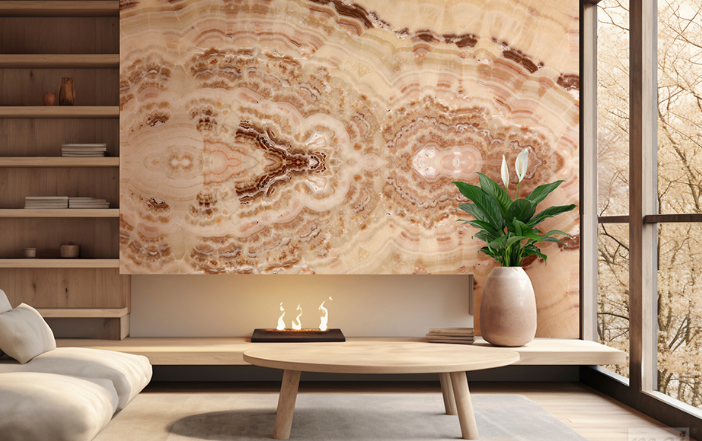
The result is a stone that behaves almost like stained glass. Hold a slab up to a light source and you will see veins, bands, and pools of colour that do not exist in any other natural material. Honey onyx radiates a warm golden glow. White onyx produces an ethereal, almost lunar softness. Green onyx shifts between jade and emerald depending on the intensity of light behind it.
This is not a quality you can manufacture or replicate with engineered alternatives. It is geology at its most artistic.
The Rise of Backlit Onyx in Luxury Interiors
Backlighting onyx is not a new idea, but advances in LED technology and thinner panel systems have made it far more accessible than it was a decade ago. What was once reserved for five-star hotel lobbies and high-end commercial fitouts is now appearing in residential projects across Sydney and beyond.
The principle is straightforward. A slab of onyx is mounted in front of a calibrated LED light panel, allowing even, diffused light to pass through the stone from behind. The slab appears to glow from within, transforming a wall, bar front, or vanity surround into something that feels more like a gallery installation than a standard interior surface.
Designers are using backlit onyx across a growing range of residential applications. Feature walls in living rooms and entryways are among the most popular, creating a focal point that sets the tone for an entire home. Bar fronts and entertainment areas benefit from the warm, ambient glow that honey and amber varieties produce.
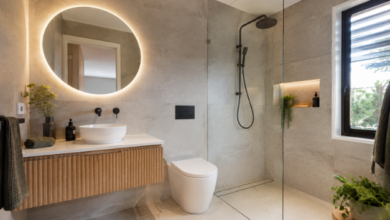
Bathroom vanity surrounds and shower niches are another growing application. A backlit onyx panel behind a freestanding bath creates a spa-like atmosphere that feels indulgent without being excessive. The stone does the work. No additional art, no wallpaper, no layered styling required.
Kitchen splashbacks are getting the treatment too. A slim panel of backlit white onyx behind a cooktop can turn a functional space into something quietly extraordinary.
Designing with Onyx: What to Consider
For all its beauty, onyx is a stone that demands respect from a design and installation perspective. It is softer than marble and considerably softer than quartzite or granite, which means it is best suited to vertical applications and low-traffic surfaces rather than heavy-use benchtops. Feature walls, cladding, vanity surrounds, bar fronts, and decorative panels are where onyx performs at its best.
Finish matters too. A polished finish will enhance translucency and colour depth, making it the go-to choice for backlit installations. A honed finish, while beautiful, absorbs more light and reduces the glow effect, so it tends to work better in applications where backlighting is not the primary feature.
Thickness is another consideration. Thinner slabs allow more light transmission, but they also require careful handling and structural support during installation. Working with experienced fabricators who understand the material’s characteristics is essential. Onyx is not a stone you want cut or installed by someone unfamiliar with its nature.
Sourcing Onyx: Why the Slab Matters More Than the Sample
One of the most important things to understand about onyx is that no two slabs are alike. The variation from one slab to the next, even within the same quarry block, can be significant. Colour intensity, vein patterns, translucency levels, and the overall mood of the stone can shift dramatically.
This is precisely why selecting onyx from a small sample tile is a gamble. A five-centimetre chip cannot tell you how a full slab will behave when light passes through it. It cannot show you whether the veining will create the effect you are imagining at the scale of a feature wall or bar front.
The only reliable way to choose onyx is to see and assess the actual slab. Visit a specialist supplier with a curated collection, stand in front of the stone, and if possible, ask to see it backlit. This is where the material reveals its true personality, and it is the step that separates a good onyx installation from a breathtaking one.
Australian homeowners have the advantage of access to specialist stone galleries where slabs can be viewed at full scale and, ideally, backlit on site. This hands-on process ensures that the stone you choose is the one you fall in love with, not a close approximation.
A Material for Those Who Want More
Onyx is not the right stone for every room. It is not a workhorse benchtop material, and it is not for homeowners who want something predictable. But for those willing to invest in something genuinely extraordinary, it offers a design experience in a category of its own.
A well-placed backlit onyx installation does not just decorate a space. It defines it. It gives a room atmosphere and emotion that visitors remember long after they leave.
And that, for any homeowner with an eye for design, is exactly the point.