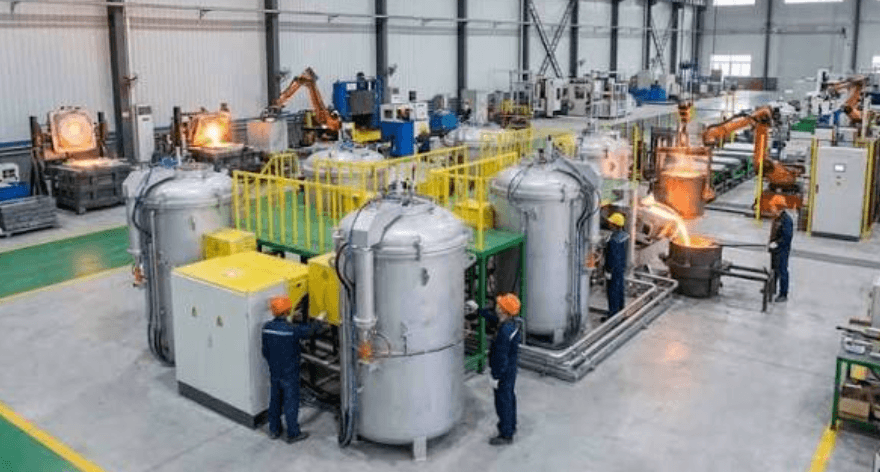
Walk through a metal foundry, a semiconductor fabrication facility, or a chemical processing plant, and graphite components are almost certainly working quietly somewhere in the background, handling tasks that few other materials could survive. The reach of graphite manufacturing across such a wide range of demanding industrial sectors is a testament to just how uniquely suited this material is to environments involving extreme heat, corrosive chemicals, or the need for precise electrical conductivity. Understanding exactly where and why graphite performs so well across these different industries helps buyers make more informed decisions when sourcing components for their own operations.
Metallurgy: The Original Graphite Stronghold
Metallurgical applications remain one of the largest and most established markets for graphite manufacturing, and for good reason. Molten metal processing involves temperatures that would instantly destroy most conventional materials, yet graphite electrodes, crucibles, and stirring rods routinely handle direct contact with molten metal without significant degradation. Graphite electrodes play a central role in electric arc furnace steelmaking, where they conduct the enormous electrical currents needed to generate the intense heat required to melt scrap steel. Graphite crucibles, meanwhile, provide the vessel of choice for melting precious and non-ferrous metals in both industrial foundries and specialized laboratory settings, prized for their resistance to thermal shock and chemical erosion from molten material.
Graphite rotors deserve particular mention within metallurgical applications, since they play a specifically important role in molten aluminum treatment and degassing processes. High-quality graphite rotors introduced into molten aluminum help remove dissolved hydrogen and other impurities, directly affecting the quality of the finished aluminum product, which is precisely why the consistency and quality of graphite manufacturing behind these components matters so much to downstream metal quality.
Semiconductor Manufacturing: Where Purity Is Everything
The semiconductor industry places extraordinarily demanding purity requirements on the materials it uses, and high-purity graphite has become essential to several critical processes in chip and wafer production. Crystal growth furnaces, used to produce the ultra-pure silicon crystals that form the foundation of semiconductor manufacturing, rely on graphite components precisely because of the material’s combination of high-temperature stability and minimal chemical contamination risk. Even trace impurities introduced by lower-quality graphite components could compromise the extremely sensitive crystal growth process, making supplier quality and material purity absolutely non-negotiable considerations in this sector.
Wafer processing equipment similarly depends on high-purity graphite components in various support and structural roles throughout the manufacturing chain, where the material’s excellent thermal conductivity and stability under repeated heating and cooling cycles make it a reliable choice for equipment that must perform consistently across countless production cycles.
Chemical Processing: Standing Up to Corrosion
Chemical processing environments present a different but equally demanding challenge: sustained exposure to highly corrosive substances that would rapidly degrade most metals. Graphite’s excellent chemical resistance makes it a natural fit for reactors, heat exchangers, and other equipment that must maintain structural integrity while in direct, prolonged contact with aggressive chemical compounds. Graphite impellers, engineered specifically for mixing and pumping corrosive liquids, showcase this application particularly well, since few alternative materials could reliably perform this function without rapid degradation.
| Industry | Primary Graphite Application | Key Property Required |
| Metallurgy | Electrodes, crucibles, stirring rods | Extreme heat resistance |
| Semiconductor | Crystal growth furnace components | Ultra-high purity |
| Chemical processing | Reactors, heat exchangers, impellers | Chemical corrosion resistance |
| EDM machining | Precision electrodes | Machinability, conductivity |
| Laboratory equipment | Crucibles, stirrers, support structures | Consistency, thermal stability |
Electric Discharge Machining: Precision Meets Conductivity
Electric discharge machining, commonly used to shape extremely hard metals that are difficult or impossible to machine using conventional cutting tools, relies heavily on graphite electrodes. This application demands a specific combination of properties from graphite manufacturing: excellent electrical conductivity to efficiently transfer the electrical discharges used in the machining process, combined with a machinable structure that allows the graphite electrode itself to be precisely shaped into complex geometries. The quality of graphite used directly affects both the precision achievable in the final machined part and the working lifespan of the electrode itself before it needs replacement.
Laboratory and Research Applications
Beyond large-scale industrial applications, graphite manufacturing also supports countless laboratory and research settings, where graphite crucibles, stirring rods, and various support structures provide reliable, chemically inert equipment for high-temperature experimental work. Researchers value graphite in these settings for the same fundamental reasons industrial users do , predictable performance under extreme conditions and resistance to chemical reaction with the materials being studied , though laboratory applications often demand smaller, more precisely specified custom components than large-scale industrial use.
Understanding Graphite Grades
Not every application calls for the same graphite specification, and understanding how different grades are optimized for different priorities helps buyers select the right material rather than defaulting to a generic, one-size-fits-all option. Isostatically pressed graphite generally offers the most uniform, fine-grained structure, making it well suited to applications requiring extremely tight machining tolerances and consistent properties in every direction. Vibration-molded and extruded graphite grades, while sometimes offering less directional uniformity, can provide cost advantages for larger components where the absolute finest grain structure is less critical to overall performance.
Different grades are also optimized to prioritize specific properties depending on application needs. Some formulations emphasize maximum electrical conductivity for electrode applications, others prioritize mechanical strength for structural components subjected to significant physical loading, and still others focus on achieving maximum purity for sensitive applications like semiconductor crystal growth where even trace contamination cannot be tolerated. A knowledgeable graphite manufacturing partner should be able to guide buyers toward the appropriate grade based on their specific operating temperature, chemical environment, and mechanical requirements, rather than simply offering a single standard product across all applications.
Customization: Matching Components to Exact Specifications
Because industrial equipment varies so significantly from one facility to another, much of graphite manufacturing revolves around producing custom-dimensioned components rather than purely off-the-shelf products. Buyers frequently need graphite rods, molds, or other components machined to precise diameters, lengths, and shapes to fit existing equipment configurations or specialized process requirements. Reputable manufacturers typically offer full OEM and ODM services, working from customer-provided drawings or samples to produce components that fit exactly into an existing system rather than requiring the buyer to redesign equipment around a standard, off-the-shelf part.
This customization capability extends beyond simple dimensional changes to include specialized shapes, such as threaded rods, stepped profiles, or complex geometries required for specific mechanical functions, demonstrating the precision machining capability that separates genuinely capable graphite manufacturers from suppliers offering only basic standard shapes.
Evaluating a Potential Graphite Supplier
When selecting a partner for ongoing graphite component needs, several factors deserve careful consideration beyond simple price comparison. Material certification and documented test reports provide crucial assurance of consistent quality, particularly for applications like semiconductor manufacturing where material purity directly affects production outcomes. A manufacturer’s demonstrated experience across the specific application in question , whether that is metallurgical electrodes, chemical processing equipment, or precision EDM electrodes , indicates a deeper understanding of the particular performance demands that application will place on the finished component.
Technical support capability is another important differentiator. Manufacturers who can offer genuine engineering guidance on grade selection, based on a buyer’s specific operating conditions, provide significantly more value than suppliers who simply fulfill orders without deeper technical consultation. This is particularly valuable for buyers working in complex or unusual applications where the ideal graphite grade and specification may not be immediately obvious.
Global logistics capability rounds out the key evaluation criteria for many buyers, since reliable, timely delivery of properly packaged graphite components , some of which can be surprisingly fragile despite their overall structural strength , matters enormously for operations that depend on these components to keep critical industrial processes running without disruption.
Building a Long-Term Sourcing Relationship
Given how central graphite components often are to critical industrial processes, most buyers find significant value in developing an ongoing relationship with a trusted graphite manufacturing partner rather than sourcing components on a purely transactional, order-by-order basis. A supplier who understands a buyer’s specific applications, maintains consistent quality across repeat orders, and can provide responsive technical support when new challenges arise becomes a genuine operational asset over time. Reviewing a comprehensive graphite manufacturing product range early in the supplier evaluation process helps buyers gauge both the breadth of a manufacturer’s capabilities and their depth of specialization across the specific product categories most relevant to their industry, making it easier to identify a partner capable of supporting long-term operational needs rather than just a single one-time purchase. For buyers managing components across multiple applications, working with a single established graphite manufacturing partner also simplifies quality consistency and technical support across an entire product range.