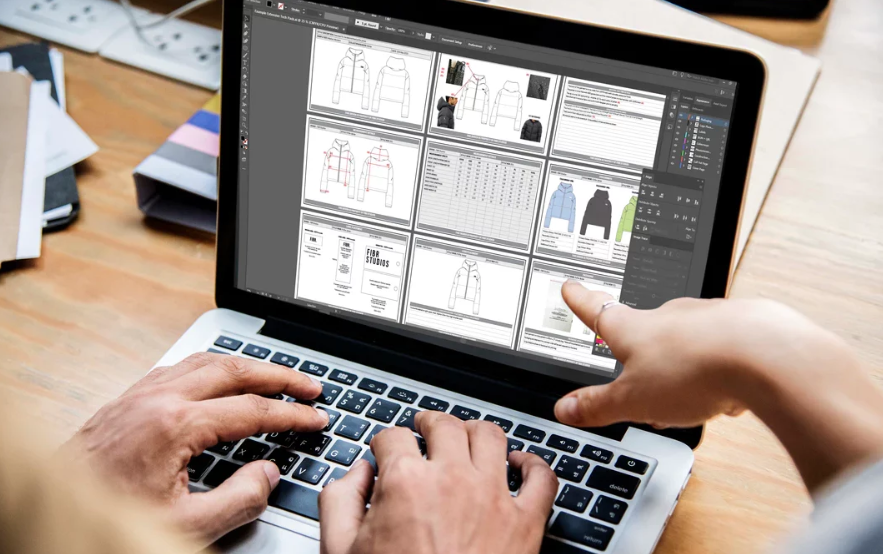
The role of Tech Pack Maker is critical in converting a design into reality. TPMs are professionally titled as Technical Designers. They work as a high-tech “liaison” between the abstract design and fashion reality. TPM is a person responsible for covering imagination in the rigorous world of industrial manufacturing.
The main purpose of the TPM is to create a blueprint of all production-ready material. It eliminates guesswork and minimizes costly errors in production. This reduces the overall production cost and saves precious time.
The Core Roles of a Tech Pack Maker
The tech pack maker(TPM) technical role is crucial for converting an imaginary design into a real-time reality.
1. Technical Translation
The Tech Pack Makers transform imaginary design into reality. They prepare 2D black-and-white drawings reflecting the garment from every angle. These drawings include (front, back, and side) with precision. The drawing lines represent every seam, dart, and stitch of the clothing.
- Importance: These drawings serve as the visual language for the workers. Most of the time, they may not speak the same language as the designer. The TPM provides an agreed-upon document for both the designer and manufacturer.
See also: Enhancing Metal Fabrication with Modern Positioning Technology
2. Establishing the “BOM” (Bill of Materials)
TPM prepares the Bill of Materials (BOM) and acts as a “recipe” for the garment.
The BOM has all the details of every single component required for production
| Category | Key Specifications | Purpose |
| Primary Fabrics | Composition (%), Weight (GSM), and Finish (e.g., brushed, peach). | Defines the main body and “hand-feel” of the garment. |
| Trims & Hardware | Buttons, zippers, elastics, and thread (type/Tex/color). | Ensures structural integrity and aesthetic accents. |
| Labels & Packaging | Brand labels, care tags, hangtags, and folding/polybag specs. | Maintains brand identity and prepares items for retail. |
3. Measurement & Grading Specs
The tech pack maker (TPM) defines the Points of Measure (POM) of different garments. The TPM sets the dimensions for a “base size” of medium-sized garments. The grading rules apply mathematically, measured from XS to XXL. The POM documents are shared between the designers and the manufacturer.
- Impact: The POM document ensures a consistent fit across the entire size range. This protects the brand’s reputation for quality and ensures a smooth production process.
4. Quality Control & Fit Evaluation
The TPM audits a “Fit Sample” sent by the production unit. It provides a recommendation about the sample and suggests alterations.
- Acceptable margin of error: TPM decides the acceptable margin of error in the production process.
| Core Role | Short Description | Key Outcome |
| 1. Technical Translation | Converts artistic sketches into detailed 2D black-and-white Technical Flats. | Visual blueprints for factories. |
| 2. Establishing the BOM | Lists all “ingredients” (fabrics, trims, hardware, and labels). | Accurate material sourcing. |
| 3. Measurement & Grading | Defines base size dimensions (POM) and applies math for size ranges (XS-XXL). | Consistent fit across all sizes. |
| 4. Quality & Fit Evaluation | Audits physical samples against specs and provides corrective “Fit Comments.” | Reduced errors and sample waste. |
Take Away:
The purpose of the TPM is to create a blueprint for the production process. The quality management of the production is based on the recommendations of TPM. TPM reduces overall production cost and ensures quality control.