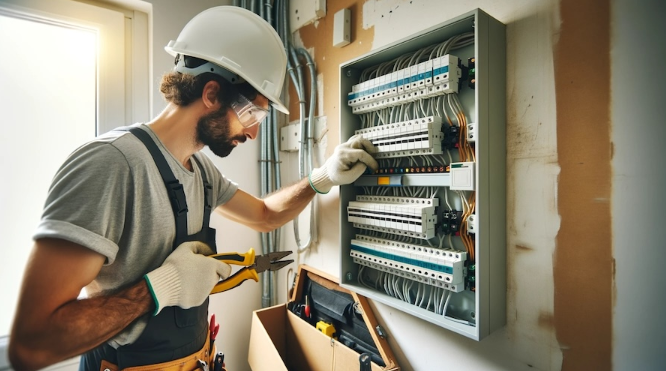
Honestly, when was the last time you even looked at that grey box on the wall? The one with all the switches, usually hiding in the laundry or hallway. Most people walk right past it every day and never really think about it.
Until something goes wrong.
Then you are standing there in the dark, flicking breakers and hoping like mad the lights come back on.
Here is the thing about switchboards. It is the heart of your whole electrical system. When it is healthy, everything just works. When it starts going bad, problems can hide for a long time before you notice. And by the time you do notice, things might already be dangerous.
Here in Queensland, with our hot summers, coastal humidity, and everything in between, knowing when to upgrade your switchboard matters. Not for looks. For safety.
Let me walk you through the signs that your switchboard needs some attention. No fancy talk. Just what you need to know.
Sign One: You Still Have Those Old Ceramic Fuses
Go have a look inside yours if you are comfortable. If you see round ceramic things with little windows and thin wire inside, that is an old fuse box.
They were standard back in the day. But in now they are trouble.
They just cannot handle the way we use power now. Run the air con, microwave, and kettle at once and those old fuses can overheat. They also give you no protection if something goes wrong. No safety switch to save you. If electricity leaks out, you are the path to ground.
A modern board has circuit breakers and safety switches. Breakers trip when a circuit is overloaded, stop wires getting hot enough to start a fire. Safety switches, the ones with the T button, kill the power in milliseconds if electricity leaks out somewhere it should not, like through you. They save lives.
If you have ceramic fuses, a switchboard upgrade Brisbane homes rely on is not a suggestion. It is a must.
Sign Two: Your Safety Switches Are Missing or Old
Safety switches are those devices with the T button. You are supposed to press them every three months to make sure they still work.
In older homes, it is common to have one safety switch protecting the power points, but nothing on the lights. That is not good enough anymore. The current requirements mandate circuits to have safety switches.
When your switchboard does not have safety switches at all, or has only one which is only covering part of the house, then you are lacking important protection. You are playing Russian roulette every time you flip on a switch.
A proper upgrade adds safety switches to every circuit. That way, if a fault develops anywhere in your home, the power cuts instantly. Before anyone gets hurt.
Sign Three: Flickering Lights and Frequent Tripping
Your house talks to you. You just have to listen.
Lights that flicker or dim when the air conditioner kicks on.Circuit breakers that trip all the time. Switches that feel warm to the touch. All of these are your home telling you something is wrong.
Sometimes it is just an overloaded circuit. You have too many appliances running on the same line. But often, it points to bigger issues. Loose connections.Worn-out breakers. Wiring that cannot handle modern loads.
In coastal areas especially, humidity and salt air can corrode connections inside old switchboards. That corrosion creates resistance. Resistance creates heat. Heat leads to fires.
Do not ignore these signs. They do not fix themselves.
See also: Fashion Market and Tech Pack Maker
Sign Four: Burning Smells or Scorch Marks
This one is not a maybe. It is a get-help-now.
If you smell something burning near your switchboard, or if you see scorch marks on the cover or around breakers, you have a serious problem. Something inside is overheating. Connections are arcing. Wires are melting.
Call an electrician immediately. Do not wait. Do not try to fix it yourself.
Sign Five: Your Home Cannot Handle Modern Appliances
Consider the way you live today as compared to a decade ago.
Maybe you have ducting air conditioning, an induction cooktop, a home office with computers and monitors, an EV charger in the garage, all these pull power in a manner that the older switchboards were never made for.
A switchboard upgrade is frequently needed anyway, in case you are going to have solar panels or install a battery system. They all need proper protection, isolation and space. An old board may not have the capacity or safety features to handle them.
In Brisbane, where more homes are adding solar and batteries every year, upgrading your switchboard now means you are ready for whatever comes next.
Sign Six: Your Switchboard Is More Than 20 Years Old
Age matters. Even if nothing seems wrong, components wear out over time. Breakers get tired. Connections loosen. Materials degrade.
Most manufacturers recommend replacing switchboard components after 20 to 30 years. If your home was built in the 90s or earlier and the switchboard has never been touched, it is living on borrowed time.
In Bundaberg, where coastal humidity and salt air can accelerate corrosion, old switchboards are especially at risk. That salt air gets inside metal enclosures and quietly eats away at connections. You might not see it until something fails.
A switchboard upgrade Bundaberg homeowners trust gets you a modern, sealed enclosure that handles the local climate better. New components. Clean connections. Peace of mind.
Sign Seven: Messy Wiring and No Labels
Open your switchboard. What do you see?
If wires are a tangled mess, if circuits are not labelled, if there are random add-ons crammed into spaces they do not fit, that is a red flag. Over the years, as homes get renovated and new circuits added, some switchboards end up looking like spaghetti.
That mess traps heat. It makes loose connections more likely. It makes fault finding nearly impossible. And it increases fire risk.
A proper upgrade gives you a clean, organised board with every circuit clearly labelled. You know which switch controls what. An electrician can work on it without guessing. That matters when something goes wrong.
What a Switchboard Upgrade Actually Involves
If you decide to upgrade, here is roughly what happens.
A licensed electrician comes out and assesses your existing board. They check your mains cable size, earthing, and how many circuits you need.
They design a new board with modern circuit breakers and safety switches on every circuit. They may recommend RCBOs, which are combination units that do both jobs in one device, especially if space is tight.
On installation day, they turn the power off for several hours. They remove the old board and install the new one. Every connection is secured properly. Then they test everything. Safety switch trip times, earth fault loop impedance, insulation resistance. All of it.
When they are done, you get a Certificate of Electrical Safety. That piece of paper is your proof that the work meets Australian Standards. Keep it safe.
Most standard homes can be done in a day. The power is off while they work, so plan around refrigeration and working from home.
What It Costs
Every home is different so what you pay depends on a few things. Size of your place.How many circuits you need.Whether your mains or meter need work too.
In Brisbane, most standard homes land somewhere in the range you would expect for this kind of job. Adding room for future stuff like solar panels or an EV charger might cost a bit more upfront but saves you ripping into things later.
Down in Bundaberg, similar story. Local sparkies can come out, have a look at your place, and give you a proper quote based on what you actually need.
One thing worth remembering. The cheapest quote is rarely the best. You want someone who does tidy work, uses decent gear, and backs it up with a proper guarantee. That is money well spent.
Queensland Rules You Should Know
Queensland has its own electrical safety laws and they matter for switchboards.
Since the start of 2025, anyone heading into a roof space for work has to turn the power off at the switchboard first. Does not matter if you are a sparky or a plumber or putting in insulation.Power off.Fines if you do not.
That rule alone is a good reason to make sure your switchboard is easy to get to and actually labelled properly. If someone needs to kill the power in a hurry, they need to know which switch does what.
New boards also have to meet the latest Australian standards. Early 2026 saw updated versions of AS/NZS 61439.1 and AS/NZS 61439.2:2026 come into effect. They cover the rules for switchgear assemblies. Your electrician will make sure whatever they put in ticks all those boxes. That is their job.
FAQs
1. What do I do to determine whether my switchboard requires upgrading?
Find those old ceramic fuses with the little windows. Ensure that you have safety switches on all the circuits. Flashing lights and switching fuses constantly. When your house is more than 20 years old and the board has never been touched, then you should have a sparky check it out.
2. How do you contrast a circuit breaker and a safety switch?
Circuit breakers prevent overheating of your wires and the creation of fire. The T button switch is the switch that is designed so that you do not get killed in the event of a malfunction. You need both. They do different jobs.
3. Can I upgrade my switchboard myself?
No chance. Has to be a licensed electrician.Illegal and bloody dangerous to do it yourself. Shock or fire risk is just not worth it.
4. How long does a switchboard upgrade take?
Most standard houses are done in a day. Power will be off for a few hours while they work so plan around that.
5. Do I need a switchboard upgrade for solar or an EV charger?
Often yes. Those systems draw serious power and need proper protection. An old board might not have the capacity or safety features to handle them. Get it checked first.
6. What is an RCBO?
A combination unit that is both a circuit breaker and a safety switch in one device. It saves space and gives full protection on a single circuit.
7. My switchboard has asbestos. What should I do?
Some older switchboards have asbestos backing sheets. Do not disturb them. A licensed electrician can assess and arrange safe removal if needed.
8. Will a new switchboard stop my breakers from tripping?
A properly designed board reduces unnecessary tripping by balancing circuits and using modern protection. But if there is a genuine fault, it will still trip for safety.
The Bottom Line
Your switchboard just sits there doing its job year after year. You never give it a thought until something goes wrong. And by then, it might already be too late.
If your house still has those old ceramic fuses, if your lights flicker, if breakers trip all the time, or if the board has not been touched in over 20 years, do not put it off. Get it sorted now. Not next year. Now.
Upgrading your switchboard is not about ticking boxes for some inspector. It is about making sure your family stays safe. No shocks. No fires. It means your air con and appliances can run without struggling. It means when you finally get around to solar or an EV charger, your home is ready to go. And it means every time you flick a switch, you are not wondering if something bad is going to happen.
In Bundaberg, with that salty coastal air eating away at old gear, a proper upgrade means your home can handle the climate and everything modern life throws at it.
Not sure how old your switchboard is or if it is safe? Call a licensed sparky. Get them to have a look. They will tell you straight.