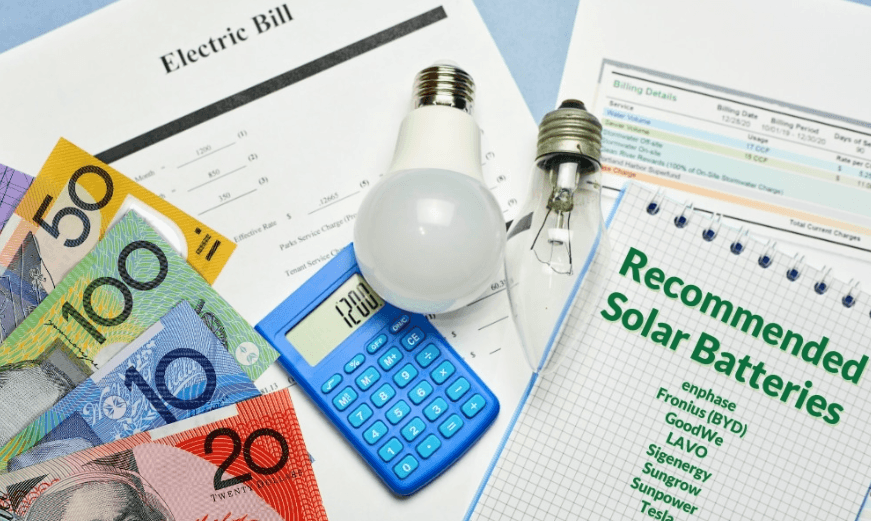
Electricity prices in New South Wales have risen significantly over the past decade, and many households are looking for reliable ways to reduce their ongoing energy costs. Solar panels alone offer substantial savings, but adding a battery to the system takes the financial benefits considerably further by allowing households to store and use energy on their own terms.
The combination of rooftop solar and battery storage has become increasingly accessible to Australian households as the cost of battery technology has continued to decline. What was once a premium addition available only to early adopters is now a practical investment for a broad range of homeowners across regional and coastal NSW looking to take greater control of their energy use.
How solar battery storage works
A solar battery stores the excess electricity generated by your rooftop panels during the day rather than sending it back to the grid for a feed-in tariff. This stored energy is then available to power your home in the evening and overnight, when your panels are no longer generating and grid electricity prices are often at their highest.
Most modern home battery systems operate automatically, managing the charge and discharge cycle without any input required from the homeowner. The system prioritises self-consumption of solar generation, sends excess energy to the battery once the home’s immediate needs are met, and only draws from the grid when both solar generation and battery storage have been exhausted.
Understanding the costs involved
Understanding the price for solar batteries is the first step for any homeowner considering adding storage to an existing solar system or installing a combined solar and battery package from the outset. Battery prices have dropped considerably in recent years, and the combination of reduced hardware costs and available government rebates has made the investment case much stronger for NSW households.
The payback period for a battery system depends on several factors, including the size of your solar array, your household energy consumption patterns, the electricity tariff you pay, and the feed-in tariff you currently receive. Homes that use a lot of energy in the morning and evening, rather than during peak solar generation hours, typically benefit the most.
Feed-in tariffs versus self-consumption
NSW homeowners with solar panels receive a feed-in tariff for excess electricity exported to the grid, but these rates are considerably lower than the retail price of electricity. Rather than exporting surplus generation at a low rate and then buying it back at a much higher rate in the evening, a battery allows you to retain and use that energy yourself.
The financial advantage of self-consumption over export grows as the gap between the retail electricity rate and the feed-in tariff widens. For many households in NSW, this gap is now large enough that the economics of battery storage stack up convincingly, even before accounting for the protection a battery provides against future retail electricity price increases.
Time-of-use tariff structures, where electricity costs more during peak evening hours and less during off-peak periods, further improve the financial case for battery storage. Charging the battery during cheaper periods and drawing from it during expensive peaks can meaningfully reduce quarterly bills, particularly for households with high evening energy consumption.
Choosing the right battery capacity
Selecting an appropriately sized battery for your household is essential to getting good value from the investment. An undersized battery fills up quickly and fails to capture all available surplus generation, while an oversized battery may never reach a full charge and delivers a poor return on the additional capital invested in excess capacity.
For business owners who are also exploring ways to grow their brand online, investing in strategies like blog seo alongside practical home improvements can help build a stronger presence across multiple fronts. Energy savings free up household budget that might otherwise be directed toward ongoing operational costs, creating space for investment in other priorities.
Most installers recommend basing battery sizing on your evening energy consumption, which represents the demand that cannot be met by solar generation alone. A battery capable of covering your household’s average evening usage provides a meaningful level of grid independence without the diminishing returns that come with significantly oversizing the system.
See also: The Importance of Customer-Centric Business Models
Maximising the return on your investment
Adjusting your energy consumption habits to align with solar generation patterns maximises self-consumption and reduces the amount of grid electricity you need to purchase. Running energy-intensive appliances like dishwashers, washing machines, and dryers during the middle of the day, when solar output is at its peak, reduces the demand placed on both the battery and the grid.
Regular monitoring of your system’s performance through the app or monitoring platform provided by your installer helps you track how well the battery is performing relative to your expectations. Most modern systems provide real-time data on generation, consumption, battery state of charge, and any grid import or export occurring at any point in the day.
Government rebates and incentive programmes available in NSW can meaningfully reduce the upfront cost of a solar battery system. Checking current eligibility requirements and deadlines before committing to a purchase ensures you capture every available financial benefit and make the most informed investment decision based on your household’s specific energy needs.
Adding battery storage to a solar system is one of the most practical and financially sound decisions a NSW homeowner can make in the current energy environment. The combination of reduced grid dependence, lower electricity bills, and improved resilience during grid outages delivers both immediate and long-term value to households across the state.
Battery storage systems also provide a degree of energy independence that solar panels alone cannot deliver. During grid outages caused by storms, network faults, or other disruptions, a battery-backed solar system can continue to power essential loads in the home, including lighting, refrigeration, and communications, without relying on the distribution network at all.
The environmental benefits of solar battery storage complement the financial case for investment. By maximising the proportion of the home’s electricity needs met by clean solar generation, a battery system reduces the household’s contribution to grid carbon emissions and supports the broader transition to renewable energy that is underway across Australia.
As battery technology continues to improve and costs continue to decline, the economics of storage will only become more compelling for NSW households. Those who invest now benefit from current incentive programmes and lock in a level of energy cost certainty that becomes increasingly valuable as retail electricity prices continue their historical upward trend across the state.