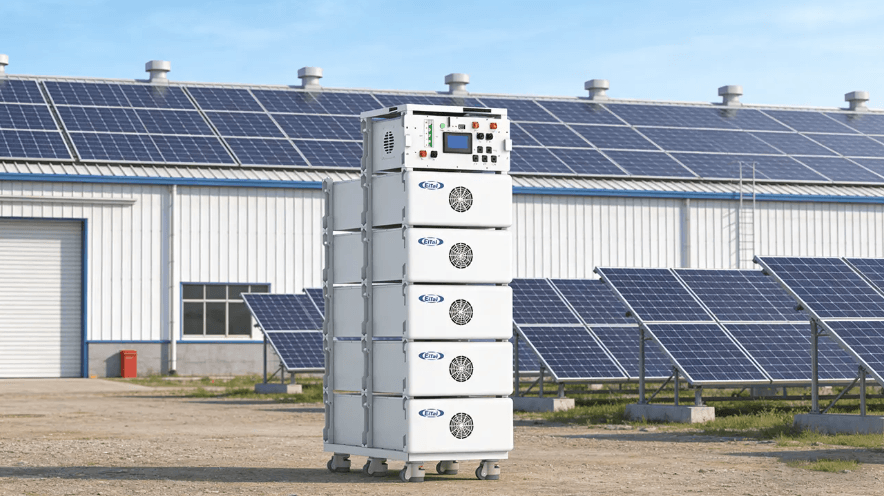
As more businesses explore energy storage as part of their energy strategy, understanding the underlying technology becomes essential for making informed decisions. C&I energy storage systems have evolved significantly in recent years, with improvements in battery chemistry, system design, and software intelligence driving better performance and reliability for commercial and industrial applications.
This article takes a closer, technology-focused look at how C&I energy storage systems are designed, what technical factors influence performance, and what business decision-makers should understand before evaluating specific solutions.
Battery Chemistry: The Foundation of Modern Energy Storage
Most modern C&I energy storage systems are built around lithium-ion battery technology, though several distinct chemistries exist within this category, each with different performance characteristics.
Lithium Iron Phosphate (LFP) batteries have become increasingly popular in commercial applications due to their strong safety profile, long cycle life, and stable performance across a wide temperature range. LFP batteries are generally considered lower risk in terms of thermal runaway compared to some other lithium-ion chemistries, making them a common choice for stationary commercial storage applications.
Nickel Manganese Cobalt (NMC) batteries offer higher energy density, meaning more storage capacity in a smaller footprint, but typically come with different safety and thermal management considerations compared to LFP systems.
Understanding which chemistry a given system uses helps businesses evaluate safety considerations, expected lifespan, and performance characteristics relevant to their specific application.
Core System Architecture
A complete C&I energy storage system involves several integrated components working together, each playing a distinct technical role:
- Battery Modules – The core energy storage units, typically organized into racks or containers for larger installations
- Battery Management System (BMS) – Monitors individual cell health, manages charging/discharging within safe parameters, and protects against overcharge or thermal issues
- Power Conversion System (PCS) – Converts stored DC energy into AC power compatible with facility electrical systems
- Energy Management System (EMS) – The “brain” of the system, executing charge/discharge strategies based on facility needs and utility rate structures
- Thermal Management System – Maintains optimal operating temperature for battery health and safety
- Safety and Fire Suppression Systems – Critical for larger installations, particularly in enclosed or indoor environments
Each of these components must be properly integrated and sized correctly relative to the others for the system to perform reliably over its intended lifespan.
Understanding Key Performance Metrics
When evaluating C&I energy storage systems, several technical metrics are particularly important for understanding expected performance:
- Usable Capacity (kWh) – The actual amount of energy the system can store and discharge, which is typically somewhat lower than the nameplate capacity due to depth-of-discharge limitations
- Power Rating (kW) – The maximum rate at which the system can charge or discharge, which determines its ability to handle sudden demand spikes
- Round-Trip Efficiency – The percentage of energy retained through a full charge-discharge cycle, with modern lithium-ion systems typically achieving 85-95% efficiency
- Cycle Life – The number of charge-discharge cycles a battery can undergo before capacity degrades below a usable threshold
- Depth of Discharge (DoD) – The percentage of total capacity that can be safely used without significantly impacting battery longevity
See also: Understanding Business Registration in Singapore: The Complete Process
Technical Comparison of Common Battery Chemistries
The table below compares key technical characteristics of the most common battery chemistries used in C&I energy storage applications.
| Characteristic | LFP (Lithium Iron Phosphate) | NMC (Nickel Manganese Cobalt) |
| Energy Density | Moderate | High |
| Thermal Stability | Very High | Moderate |
| Typical Cycle Life | 6,000–10,000+ cycles | 3,000–6,000 cycles |
| Safety Profile | Excellent | Good, requires more thermal management |
| Cost per kWh | Generally lower | Generally higher |
| Common Applications | Stationary commercial storage | Applications prioritizing compact size |
This comparison illustrates why LFP chemistry has become particularly popular for stationary C&I applications, where safety and long cycle life are often prioritized over compact size.
The Role of the Energy Management System
The energy management system (EMS) is arguably the most important component in determining how effectively a C&I energy storage system delivers financial and operational value. A sophisticated EMS uses algorithms to analyze facility energy usage patterns, utility rate structures, and, where applicable, solar generation data to optimize charge and discharge timing automatically.
Advanced EMS platforms can also incorporate predictive analytics, adjusting strategies based on weather forecasts, expected demand patterns, or seasonal variations, further improving system performance without requiring manual intervention from facility staff.
Thermal Management and Safety Design
Proper thermal management is critical for both battery performance and safety. Most modern C&I systems incorporate active cooling or heating systems to maintain batteries within their optimal operating temperature range, which directly impacts both performance and long-term degradation rates.
Safety design has become an increasingly important focus area for the energy storage industry, particularly following high-profile incidents involving poorly designed systems. Businesses evaluating energy storage providers should specifically inquire about thermal management design, fire suppression systems, and compliance with relevant safety standards and certifications for their region.
Scalability and Modular Design
Many modern C&I energy storage systems are designed with modular architecture, allowing businesses to start with a smaller system and expand capacity over time as needs grow or budget allows. This modular approach can be particularly valuable for businesses uncertain about their exact long-term energy storage needs, or those looking to phase capital investment over multiple budget cycles.
Integration with Existing Electrical Infrastructure
Successful C&I energy storage deployment requires careful integration with a facility’s existing electrical infrastructure. This includes considerations such as:
- Compatibility with existing switchgear and electrical panels
- Integration with any existing solar photovoltaic systems
- Communication protocols for interfacing with building management systems
- Space and structural requirements for battery installation
Working with providers who have strong technical integration experience helps reduce the risk of installation complications or compatibility issues that could delay project timelines.
Monitoring and Remote Management Capabilities
Most modern C&I energy storage systems include cloud-based monitoring platforms that provide real-time visibility into system performance, charge/discharge patterns, and overall battery health. These platforms often include alert systems that notify facility managers of any performance anomalies, allowing for proactive maintenance rather than reactive troubleshooting.
Remote management capabilities also allow providers to perform software updates and system optimizations without requiring on-site visits, which can meaningfully improve system performance over time as algorithms and control strategies are refined.
Evaluating Technical Proposals from Providers
When comparing technical proposals from different C&I energy storage providers, businesses should request detailed information about battery chemistry, system architecture, safety certifications, and EMS capabilities, rather than focusing solely on total capacity and price. A technically sound system with a well-designed EMS often delivers significantly better real-world performance than a system with similar specifications but less sophisticated control software.
Final Thoughts
Understanding the technical foundations of C&I energy storage , from battery chemistry and system architecture to energy management software and safety design , equips business decision-makers to evaluate potential solutions more critically and ask more informed questions during the procurement process. As battery technology continues to advance, systems are becoming increasingly efficient, safer, and more capable of delivering measurable value across a wide range of commercial and industrial applications.
Choosing a provider with strong technical expertise and a well-engineered system design is ultimately what determines whether a C&I energy storage investment delivers reliable, long-term performance for a business’s specific operational needs.