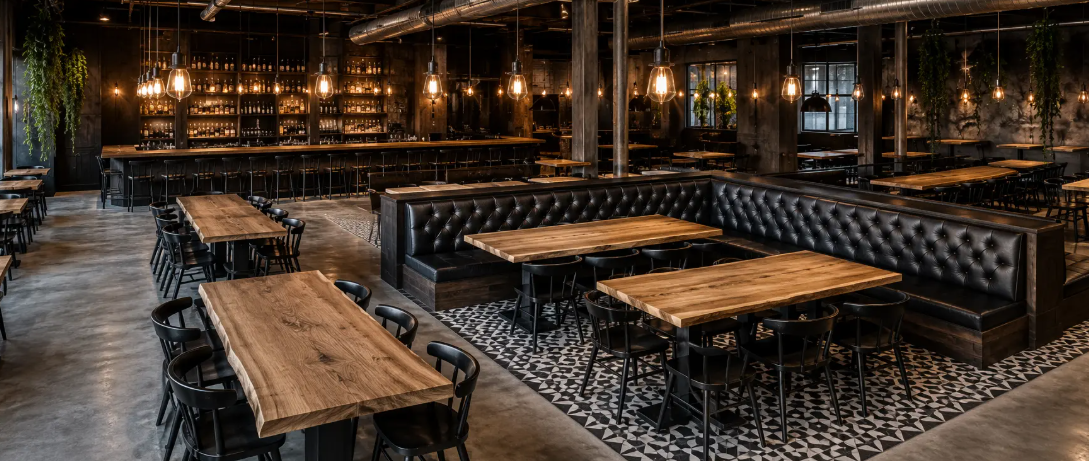
Buying booths for one room is a furniture purchase. Buying them for twelve rooms is a manufacturing and logistics exercise, and the two have almost nothing in common. The vendor list is different, the questions are different, the failure modes are different, and the thing that decides whether the program goes well is settled before anybody looks at a fabric sample.
Sourcing commercial grade restaurant booths at volume means treating them as a made-to-order product with a supply chain attached, because that is what they are. Nobody holds booth stock. Every unit is built to a dimension, in a specified material, for a specific wall, and that changes everything about how the buying works.
Booths Are Built, Not Picked
Start with the fact that separates this from every other seating purchase.
Chairs and tables exist in inventory. A buyer places an order and a warehouse ships. Booths are manufactured after the order, to dimensions taken from a drawing, which means the lead time is a production slot rather than a shipping window.
That has two consequences at volume. The order has to be placed months earlier than a comparable chair order, and any change to the dimensions after the slot is booked is a change order rather than a swap. Buyers who treat booths like chairs discover both facts late, usually at the point where the opening date is already committed.
The Dimension Set That Has to Be Right First
The second thing is that a booth order is only as good as the dimensions it was built from.
Six numbers govern everything: overall run length, unit width, seat height, seat depth, back height and the depth of the whole assembly including the table. Those have to come from a measured site rather than from a construction drawing, because the built room and the drawn room differ in almost every project.
At volume the risk compounds. Twelve sites measured from drawings will contain several that do not fit, and a booth that does not fit cannot be adjusted on site the way a table can be moved.
What Volume Actually Buys You
The third thing is understanding where the bargaining power sits, because it is not in the unit price.
Booth manufacturing is labor-heavy and the material content is a modest fraction of the cost. A large order therefore does not produce the discount curve a chair order does, and buyers who push hard on price get a small win.
What volume genuinely buys is scheduling priority, dedicated production runs that guarantee finish consistency across sites, fixed pricing across a program, and a commitment to reproduce the specification for future units. That last item is the one worth most and the one nobody asks for.
The Documentation to Require
The fourth thing is evidence, and the questions are the same ones that apply to any contract seating.
Frame construction and the material of the internal structure. Foam density and its expected recovery. Fabric abrasion rating and cleanability. Flammability conformance documentation for every padded component. Base construction and how the unit meets the floor.
Contract seating standards published by BIFMA cover strength, stability and durability for public and lounge seating, and those standards are developed under the accreditation framework coordinated by ANSI. A supplier building to them can produce a report number. One who cannot is describing a product rather than evidencing it.
Reupholstery Is the Real Service Life Question
The fifth thing is what happens in year six, and it is the question that separates good sourcing from adequate sourcing.
A booth frame lasts far longer than its upholstery. The economically correct outcome is that the frame stays and the covering is replaced, which is a fraction of the cost of a new unit and a fraction of the disruption.
That only works if the booth was built to be reupholstered: accessible fixings, a fabric attachment method that can be undone, and a supplier who will still supply matching material. Ask about all three before ordering. Most volume buyers discover the answer six years later, when the alternative is replacing the whole run.
The Installation Cost Nobody Quotes
The sixth thing is that a booth order is half a construction project and the quote rarely says so.
Fixed seating has to be leveled, secured, and finished at the floor junction. Services in the wall behind it need access panels. The floor covering has to run correctly under or up to the base. None of that is furniture work and all of it happens on the same day.
At volume, across twelve sites, an unquoted installation scope is where a program budget goes wrong. Get it priced as construction, with a named contractor, before the furniture order is signed.
What the Program Specification Should State
For a buyer sourcing booths across multiple sites:
- Site measurements taken on the built room, signed off, before any order
- The six governing dimensions stated per site, not as a standard unit
- A test report number covering strength, stability and durability
- Flammability documentation for every padded component
- Foam density and fabric abrasion rating stated numerically
- A reupholstery method confirmed, with fabric availability guaranteed in writing
- Installation quoted as construction scope, per site, with services access included
See also: A Buyer’s Guide to Sourcing Bonsai Trees Wholesale for Retail and Landscaping Businesses
Where Volume Programs Actually Fail
The Small Business Administration’s guidance on calculating costs treats fit-out as a capital event, and booth programs almost always overrun that capital number.
They rarely overrun on the furniture. They overrun on the installation that was not quoted, the change orders from sites measured off drawings, and the delay when a production slot moves because a dimension was revised. Every one of those is a sourcing failure rather than a manufacturing one.
Buyers who spend their preparation on measurement, documentation and installation scope get programs that land on budget with mediocre discounts. Buyers who spend it on negotiating unit price get an excellent price on furniture that arrives late and costs more to install than anybody budgeted.