TL;DR: For newborns, a universal pushchair footmuff from the pushchair footmuff range at For Your Little One covers the widest range of prams and travel systems without extra adaptors, and comes with a removable liner for easier washing after the inevitable milk spills. If you’re using the footmuff inside a car seat too, check compatibility first — car seat safety guidance is different from pushchair safety guidance, and that’s the single mistake parents make most often. Below is a breakdown of the footmuff types worth considering in 2026, how they differ, and which one suits which stage.
Choosing a pushchair footmuff sounds simple until you’re staring at a dozen options that all claim to be “universal fit.” This guide breaks footmuffs down by what they actually do — warmth, compatibility, washability, and car seat safety — rather than by brand names, so you can match the footmuff to how you actually use your pram. Everything referenced below is available through For Your Little One’s nursery and travel range.
How we chose
The footmuff types below are ranked on four practical criteria that matter to first-time parents: how many pushchair and travel system models the footmuff actually fits, how easy the fabric is to clean after regular use, whether it’s suitable for car seat use without compromising harness fit, and whether it adjusts as your baby grows out of the newborn stage. Products that tick more of these boxes rank higher.
1. Universal pushchair footmuffs — best all-round newborn pick
A universal pushchair footmuff is built with adjustable straps and a wide harness slot design so it fits most three-wheelers, travel systems and standard prams without buying a brand-specific adaptor. This is the footmuff type most first-time parents should start with, because it removes the guesswork of matching a footmuff to a specific pram model before you’ve even worked out your daily routine.
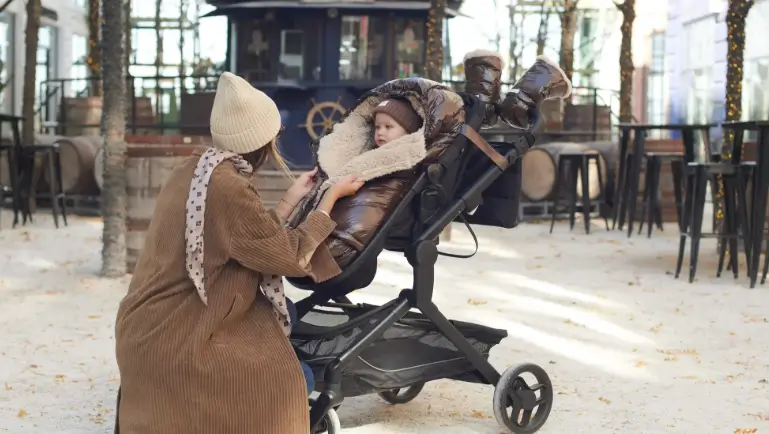
The pushchair footmuff range at For Your Little One is built around this universal-fit approach, with padded lining for newborn warmth and a foot end that typically unzips to extend as your baby grows into toddlerhood. This matters because most babies outgrow a fixed-size footmuff within a single winter, and an extendable design gets you a second season of use.
Who it’s for: parents who want one footmuff that works across pram, pushchair and stroller use without extra fittings.
Features to look for:
• Adjustable harness slots that work with 3-point and 5-point harnesses
• A removable inner liner that goes in the washing machine separately from the outer shell
• An extendable foot end for use beyond the newborn stage
• Water-resistant or showerproof outer fabric for UK weather
• A reinforced hood or head area for pram use in cold months
Limitations: universal-fit footmuffs sit slightly looser on some narrow-frame prams than a footmuff made specifically for that model, and thick padding under a car seat harness needs checking against car seat safety guidance before use (more on that below).
2. Car-seat-compatible footmuffs
Car-seat-compatible footmuffs are designed to sit under or around a baby without adding bulk beneath the harness straps, which matters because padded liners that compress in a crash can leave the harness dangerously loose. Good Egg Car Safety and other child car seat safety campaigns in the UK consistently advise against thick padded liners inside a rear-facing car seat unless the product is specifically designed and tested for that use.
If your footmuff will double up between the pram and the car seat, check the product description for explicit car seat approval rather than assuming a pushchair footmuff is automatically safe underneath a harness. For Your Little One’s best baby car seats guide covers seat selection in more depth, including what to check before adding any accessory under the harness.
Who it’s for: parents who move baby between pram and car seat multiple times a day and want one accessory that’s genuinely safe for both.
Limitations: fewer options exist in this category than in general pushchair footmuffs, because manufacturers have to design and test specifically for harness compatibility.
3. Fleece-lined footmuffs for newborns
Fleece-lined footmuffs prioritise warmth over water resistance, which makes them a strong pick for parents doing short walks or school runs rather than long outdoor stretches in wet weather. The soft inner lining sits directly against a newborn’s skin, so it’s worth checking the fabric is breathable rather than purely insulating.
The NHS advises keeping a baby’s sleeping environment between 16 and 20°C and watching for signs of overheating such as sweating or flushed cheeks — the same overheating logic applies when layering a fleece footmuff over pram bedding or a snowsuit, so one or the other is usually enough rather than both together.
Who it’s for: parents in milder or drier parts of the UK who want warmth without a heavy waterproof shell.
Limitations: less effective in sustained rain or sleet compared with a showerproof outer, so it’s not the best single footmuff for year-round use.
4. Showerproof, all-weather footmuffs
All-weather footmuffs use a water-resistant or showerproof outer shell over an insulated lining, aimed at parents who walk regardless of weather rather than only on dry days. This type tends to be bulkier than a fleece-only footmuff, which can be worth checking against your pram’s harness fit before buying.
Pairing an all-weather footmuff with a pushchair rain cover gives more complete weather protection than either product alone, since a footmuff protects the lower body while a rain cover shields the whole seat unit from wind-driven rain.
Who it’s for: parents who walk daily in typical UK autumn and winter conditions and don’t want to swap footmuffs between dry and wet days.
Limitations: the heavier fabric takes longer to dry after a soaking and adds more bulk to fold-flat pram storage.
5. 2-in-1 footmuff and blanket combinations
A 2-in-1 footmuff unzips flat into a blanket, giving you a second use for the same item once your baby has grown out of the fitted footmuff shape or when you want extra bedding for a Moses basket or car seat on cooler days. This makes it a reasonable budget-conscious choice since one purchase covers two stages.
It won’t offer the same fitted warmth around the legs as a dedicated footmuff while your baby is small, so it suits parents who want flexibility over maximum newborn-stage insulation. If you’re also setting up sleep bedding, For Your Little One’s best baby blankets for newborns guide covers safe bedding weights and fabrics in more detail.
Who it’s for: parents who want one item that outlasts the newborn footmuff stage.
Limitations: less snug fit around the harness area compared with a fitted footmuff, so it’s a secondary rather than primary choice for very young newborns.
See also: Why a Likable Person Test Will Help You Change Your Life
Quick comparison
- Universal pushchair footmuff — best all-round newborn pick, fits most pram and travel system frames without adaptors
- Car-seat-compatible footmuff — best for parents switching between pram and car seat daily
- Fleece-lined footmuff — best for milder weather and short daily walks
- All-weather showerproof footmuff — best for year-round UK conditions, pairs well with a rain cover
- 2-in-1 footmuff/blanket — best for stretching one purchase across two stages
FAQ
Do I need a footmuff if I already have a car seat and travel system?
A travel system’s own seat fabric rarely provides enough insulation for cold-weather prams alone, so a pushchair footmuff is still worth adding for autumn and winter walks, particularly for a newborn who can’t regulate body temperature as well as an older baby.
Is it safe to use a padded footmuff under a car seat harness?
Only if the footmuff is specifically designed and labelled for car seat use — general safety guidance from child car seat campaigns warns that thick padding under a harness can compress in an impact, leaving straps too loose, so check the product description before combining the two.
When can my newborn start using a pushchair footmuff?
Most footmuffs are suitable from birth, but always follow the temperature guidance on the packaging and the NHS’s advice on avoiding overheating, since a newborn in a snowsuit and a fleece-lined footmuff together can quickly become too warm.
Will a universal footmuff fit any pram or travel system?
Universal footmuffs are designed with adjustable straps to fit most standard frames, but very narrow three-wheelers or unusually shaped seat units are worth double-checking against the product’s compatibility notes before buying.
How long does a footmuff usually last before my baby outgrows it?
An extendable footmuff with an unzip-to-lengthen foot end typically covers more than one season, whereas a fixed-size newborn footmuff is usually a single-winter product.
Conclusion
For most first-time parents, a universal pushchair footmuff is the safest starting point in 2026, because it fits the widest range of prams and travel systems and typically extends as your baby grows out of the newborn stage. If you regularly move baby between the pram and the car, prioritise a car-seat-compatible design over a purely pushchair-focused one. Browse the pushchair footmuff range at For Your Little One to match warmth, weather resistance and compatibility to how your family actually uses your pram day to day.