A commercial demolition Perth project involves more planning than most business owners expect. Permits, hazardous materials and site safety all need to be sorted before any machinery arrives. Here’s what’s involved, and what separates a smooth project from a costly one.
Approvals Come Before Anything Else
Before any demolition work starts in Western Australia, the site typically requires a building permit for demolition, lodged with the relevant local council. Depending on the property’s location, age, and heritage status, this can also involve:
- A demolition licence application through the Department of Mines, Industry Regulation and Safety (DMIRS)
- Notification to Western Power, Water Corporation, and other utility providers to disconnect services
- Traffic management plans if the site borders a public road or footpath
- Heritage assessments for older commercial buildings in council-listed precincts
Skipping or rushing this stage is one of the most common causes of project delays.
Asbestos and Hazardous Materials Are the Biggest Risk Factor
Perth has a large stock of commercial buildings constructed between the 1950s and early 1990s, meaning asbestos-containing materials are common in older warehouses, retail buildings, and office fitouts. Before demolition can proceed, a licensed asbestos assessor typically needs to inspect the site and produce a hazardous materials report.
Other materials that can complicate a commercial demolition include:
- Lead-based paint on older steel and timber structures
- Contaminated soil from previous industrial use
- Mould in buildings affected by long-term water damage
Any of these can require specialist remediation before demolition equipment moves in, which is why hazardous materials assessment should happen at the planning stage, not once work is underway.
Choosing Between Full and Partial Demolition
Not every commercial demolition project means levelling a site. Businesses often need:
- Full demolition – removing a structure entirely to prepare land for redevelopment or sale
- Partial demolition – removing sections of a building for renovation, extension, or repurposing
- Strip-out demolition – clearing internal fitouts, plumbing, and services while retaining the building shell
The right approach affects cost, timeline, and which approvals are required, so it’s worth confirming this early with a contractor experienced across all three.
What a Reliable Timeline Looks Like
While every site is different, a typical commercial demolition project in Perth follows this general sequence:
- Site inspection and hazardous materials assessment
- Permit and licence applications
- Utility disconnections
- Asbestos or contaminant removal (if required)
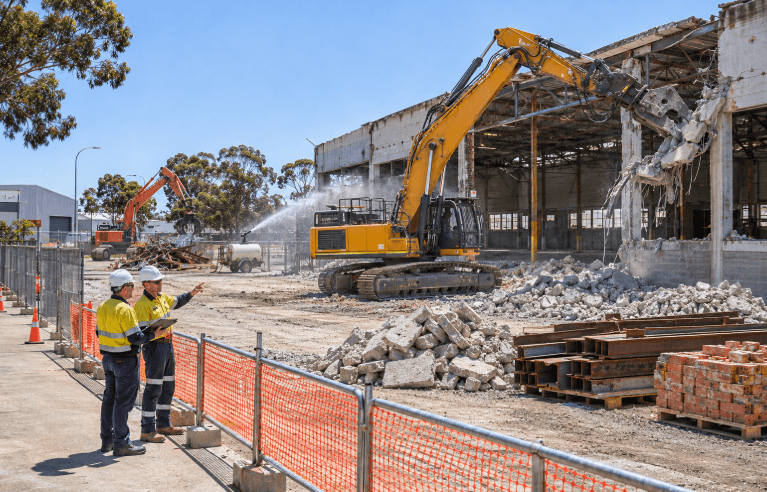
- Demolition works
- Waste sorting, recycling, and disposal
- Site clearing and handover
Projects involving asbestos or contaminated land naturally take longer, since remediation must be completed and often independently verified before demolition can proceed.
Waste Management and Recycling Obligations
Western Australia’s waste levy applies to most demolition waste sent to landfill, which is why many commercial demolition contractors now separate and recycle materials like concrete, steel, brick, and timber on-site. Beyond the cost savings, this is increasingly expected by councils and by clients pursuing sustainability targets on redevelopment projects.
Choosing a Commercial Demolition Contractor in Perth
Because of the approvals, hazardous materials handling, and safety obligations involved, commercial demolition works best with a contractor who manages the entire process end-to-end rather than one who simply carries out the physical demolition. Look for:
- Current WorkSafe and licensing accreditation
- In-house or closely partnered asbestos and hazardous waste capability
- Experience with both residential and commercial-scale projects
- A track record of managing council and DMIRS approvals directly
Businesses in Perth taking on a demolition project, whether it’s a full site clearance or a partial strip-out ahead of a fitout, are better served by a commercial demolition Perth specialist who can manage approvals, hazardous materials, and the physical works under one roof, rather than coordinating multiple contractors separately.