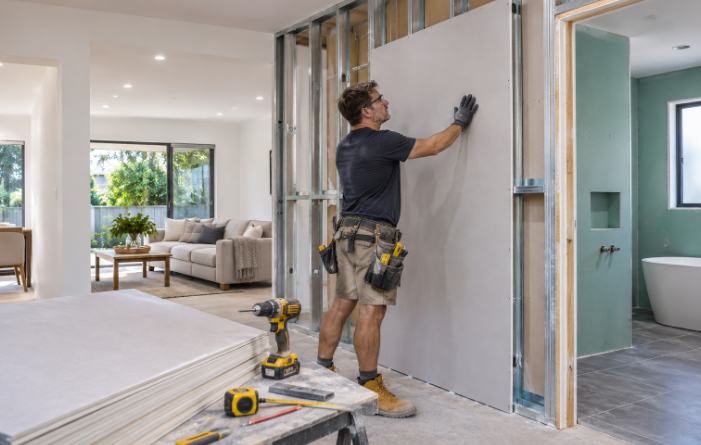
Plasterboard may look similar from one sheet to the next, but different rooms place very different demands on wall and ceiling linings. Moisture, impact, ceiling spans, sound control and fire requirements can all influence which type is appropriate. When comparing high quality plaster sheets, the useful question is not simply which board has the highest specification, but which properties suit the particular room and construction system. Choosing by application helps avoid paying for performance that is unnecessary while also reducing the risk of installing standard board where a specialised product is required.
Bedrooms and Living Areas
Bedrooms, studies and many living spaces generally have relatively mild conditions. They are not normally exposed to frequent moisture or unusually heavy impact, so standard plasterboard is commonly suitable for internal wall linings where the building design allows it.
Selection still involves more than choosing a sheet that fits the wall. Check the specified thickness, framing arrangement and installation requirements for the project. If sound transfer between rooms is a concern, an acoustic wall system may require denser or specialised plasterboard together with insulation and suitable construction details.
Ceilings deserve separate consideration. Ceiling-specific plasterboard is designed for overhead use and can offer characteristics such as improved resistance to sagging. CSR Gyprock, for example, recommends its Supaceil product for internal residential ceilings and notes that it is intended for spaces where moisture exposure is not a concern.
Bathrooms and Laundries
Wet and humid rooms require more careful material selection. Bathrooms, laundries and similar areas can expose linings to steam, splashes and elevated humidity that ordinary plasterboard is not intended to handle in the same way.
Moisture-resistant plasterboard is manufactured for these conditions. CSR Gyprock identifies Aquachek as suitable for wet and humid areas, including bathrooms and laundries, with moisture resistance incorporated into the board’s core and facing.
However, moisture-resistant plasterboard should not be confused with a complete waterproofing solution. Wet-area performance depends on the entire construction system, which may include membranes, sealants, joints, fixings and finishes appropriate to the location.
Pay particular attention around showers, baths and other areas subject to direct water exposure. The board should be selected and installed as part of a system that meets the project’s applicable wet-area requirements rather than relying on the sheet alone.
Kitchens and Garages
Kitchens can combine ordinary dry wall areas with locations affected by humidity and occasional moisture. The appropriate board can therefore vary within the same room.
A standard lining may suit sections that remain dry, while moisture-resistant products may be specified where conditions justify additional protection. Manufacturer guidance should be checked against the actual wall or ceiling location rather than assuming that every kitchen surface needs identical treatment.
Garages introduce different considerations. Moisture and changing environmental conditions may matter, but walls can also face knocks from stored equipment, bicycles, tools and other everyday activity.
Where repeated impacts are likely, a tougher plasterboard may be worth considering. Impact-resistant products use stronger construction to reduce damage in high-traffic or impact-prone areas. CSR Gyprock lists applications for Impactchek that include garages, games rooms, corridors and other areas where walls are more likely to be struck.
Hallways, Playrooms and Busy Areas
Some rooms need durability more than moisture resistance. Hallways, stairways, children’s playrooms and frequently used shared spaces tend to experience more contact from furniture, bags, toys and general movement.
Standard plasterboard can still be appropriate in many homes, but impact-resistant board may make sense where repeated damage is foreseeable. The decision should consider both the likelihood of impact and the cost of future repairs.
This is also a useful reminder that choosing the strongest board available for every room is rarely necessary. A heavy-duty sheet that is valuable in a busy corridor may offer little practical advantage on a lightly used bedroom wall.
The same principle applies to acoustic products. Extra sound resistance may be worthwhile around bedrooms, home offices, entertainment rooms or shared walls, but achieving good acoustic performance depends on the complete wall construction rather than one board characteristic alone.
Match the Board to the Complete System
Special requirements such as fire resistance should never be approached by selecting a sheet in isolation. Fire-rated plasterboard is designed for use within tested or specified wall and ceiling systems that can involve particular layers, framing, fixings, joints and installation details. CSR Gyprock describes Fyrchek as a fire-grade board intended for high-performance fire and acoustic wall and ceiling systems.
Before ordering plasterboard, work through each space separately. Identify whether the surface is a wall or ceiling, consider moisture and impact exposure, check whether acoustic or fire performance is specified, and confirm the required sheet thickness and installation system.
This room-by-room approach often produces a mix of plasterboard types across one project. That is usually more practical than treating the whole house as a single application, because the material in each location is chosen for the conditions it will actually face.