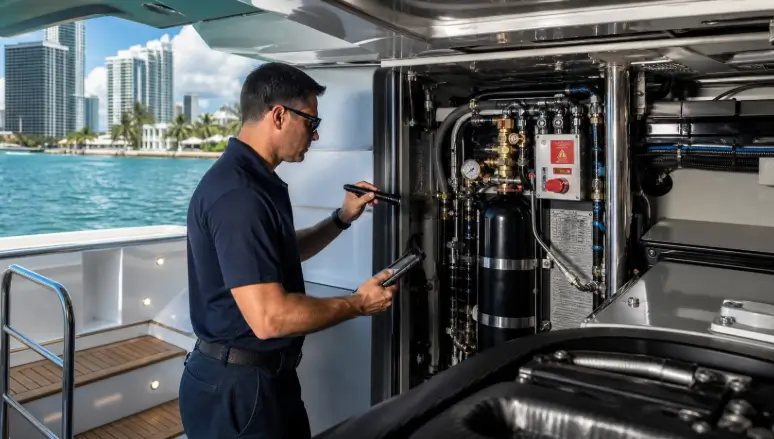
TL;DR: Miami-Dade property teams should plan around three recurring fire sprinkler service milestones: quarterly checks, annual inspections and testing, and five-year internal assessments. Each interval covers a different scope, so completing one does not automatically satisfy the others. Speedy Fire Protection provides fire sprinkler inspection services across Miami-Dade and South Florida, using the prior inspection report, system type, and property details to confirm what is due before scheduling. Start with the inspection tag, gather any open deficiency notices, and make sure the contractor documents each interval separately.
Fire sprinkler scheduling becomes easier when the service calendar is divided into quarterly, annual, and five-year work. These intervals are not interchangeable: quarterly service addresses recurring condition checks, annual service covers a broader inspection and testing scope, and five-year service reaches internal components that routine visits do not.
This guide explains what each interval is for, what to prepare, and how to schedule the correct scope for a Miami-Dade property. The exact tasks can vary by system configuration and the edition of the adopted fire code, so the prior report and equipment records should drive the appointment.
What You’ll Need
- The most recent fire sprinkler inspection tag and written report
- Records showing the last quarterly, annual, and five-year services
- The building address, occupancy use, and sprinkler system type
- Access to the riser room, fire department connection, control valves, and other test points
- A point of contact who can remain available during testing
- Any open deficiency or violation notices
- Records for related equipment such as standpipes or fire pumps, if present
Step 1: Build a Miami-Dade Inspection Calendar by Interval
Start with the dates on the latest inspection tag and reports. Create three separate entries for quarterly, annual, and five-year work rather than relying on one general “sprinkler inspection” date.
This separation matters because the intervals track different tasks. A quarterly visit does not replace the annual scope, and an annual visit does not prove that the five-year internal work has been completed. If the paperwork shows only a service date without the interval or work performed, ask the prior contractor or property manager for the full report.
List each due date with the property address, system covered, report number if available, and any deficiencies still open. Buildings with multiple risers, standpipes, or fire pumps may have more than one service date. Keeping each system on its own line prevents one completed inspection from being mistaken for full-property compliance.
Common mistake: Treating a fire alarm inspection as proof that the sprinkler system was inspected. The alarm and water-based fire protection systems have different equipment, service scopes, and records.
Step 2: Schedule the Quarterly Fire Sprinkler Check
Quarterly service is the frequent checkpoint in the maintenance cycle. It is used to review items assigned a quarterly frequency under the applicable inspection and testing program and to identify visible problems before they carry into the annual visit.
Before scheduling, confirm which components at the property require quarterly attention. The scope may include gauges and other system items depending on system type and configuration. The contractor should use the prior report and equipment inventory rather than assume every property has the same checklist.
For the appointment:
- Provide the last quarterly report and tag date.
- Confirm access to the riser room and control valves.
- Report any recent leaks, valve work, tenant construction, or changes near sprinkler piping.
- Ask whether testing will affect alarms, monitoring, or building operations.
- Keep the completed quarterly report with the property records.
A quarterly visit is also the right time to correct simple access problems. Storage in front of valves, a locked riser room, or a vehicle blocking the fire department connection can prevent the technician from completing the documented scope.
Expected outcome: A report that clearly identifies the quarterly interval, the systems and components reviewed, any deficiencies found, and the next recommended service date.
Step 3: Schedule the Annual Miami-Dade Inspection and Testing
The annual appointment is broader than a quarterly check. It should be scheduled as its own inspection and testing visit, with enough time for the contractor to review the system, perform the required annual tasks, and document the results.
Give the scheduler the property address, occupancy use, number of buildings, number of risers, and whether the property has related equipment such as a standpipe or fire pump. A small single-riser property and a multi-building campus should not be booked into the same service window.
Before the visit, confirm:
- The responsible property contact will be available.
- Riser rooms, valves, test connections, and the fire department connection are accessible.
- The monitoring company and affected occupants can be notified if testing activates alarms.
- Any open deficiencies from quarterly service are available for review.
- Recent renovations or changes in building use are disclosed to the contractor.
During the annual visit, ask the technician to identify which tasks are annual and which items remain on separate quarterly or five-year schedules. That distinction should appear in the written report.
Common mistake: Waiting for a violation notice before booking the annual visit. The due date should come from the prior annual report and service record, not from the date an enforcement notice arrives.
Step 4: Plan the Five-Year Internal Assessment Early
Five-year work requires more planning because it involves internal system areas that routine visual inspections do not reach. The exact scope depends on the system and its service history, so the contractor should review the prior five-year report before quoting or scheduling the visit.
Do not assume the latest annual inspection reset the five-year clock. Find the report that specifically documents the prior five-year internal work. If no record exists, tell the contractor when requesting the appointment rather than guessing at the completion date.
Five-year scheduling should account for:
- The number and type of systems involved
- Access to internal inspection points
- Whether water needs to be controlled or drained
- Notifications required before any planned impairment
- Time to restore the system and confirm normal service
- Repairs or follow-up testing if internal conditions reveal a problem
Book this work early enough to coordinate with tenants, facilities staff, monitoring providers, and any authority notifications that apply to the property. Healthcare, hospitality, educational, and government properties may need additional operational planning because access and shutdown windows can be limited.
Expected outcome: A report that identifies the five-year scope completed, the system areas examined, findings, corrective work if needed, and the date used for the next five-year cycle.
Step 5: Combine Visits Without Combining the Records
Quarterly, annual, and five-year work may sometimes be scheduled during the same service window when due dates align. Combining the trip can reduce disruption, but the contractor should still document each interval and scope clearly.
Before approving a combined appointment, ask:
- Which quarterly tasks will be completed?
- Which annual inspection and testing items are included?
- Which five-year internal work is included?
- Will each interval be identified on the report?
- Are related systems, such as fire pumps or standpipes, part of the quoted scope or separate?
The goal is one coordinated visit with distinct records, not one vague report labeled “annual inspection.” Clear documentation helps the property team see what was completed and what remains due.
Step 6: Confirm the BRYCER Compliance Engine Filing
Review the report before the technician leaves or as soon as it is delivered. Confirm that the property address, system identification, service interval, test date, and deficiencies are correct.
Separate the findings by interval. A deficiency found during quarterly service may need repair before the annual appointment. A condition discovered during five-year internal work may require a different repair scope than a visible annual finding. Keep the repair documentation with the report that generated it.
Effective October 1, 2026, the fire protection contractor must upload every completed system test report—compliant or deficient—to BRYCER’s The Compliance Engine for Miami-Dade Fire Rescue. Property owners and managers do not file the report themselves, but they should confirm that the contractor is registered with The Compliance Engine and that the upload was completed.
Ask for a copy of the filed report and keep it with the quarterly, annual, or five-year inspection record. If deficiencies were found, confirm how the repairs and updated status will be documented in The Compliance Engine. Properties outside Miami-Dade Fire Rescue’s jurisdiction should confirm the reporting process with the fire authority serving that address.
See also: Best Custom Notebook Printing Services for Business Branding in 2026
Common Scheduling Mistakes in Miami-Dade
The property has one inspection date for everything. Split the calendar into quarterly, annual, and five-year entries, then identify the system attached to each date.
The quarterly report is mistaken for the annual inspection. Read the stated scope and interval. A recent service date alone does not establish that annual work was completed.
The annual report is treated as proof of five-year service. Look for language that specifically identifies the internal five-year scope and the system areas examined.
The five-year visit is booked like a routine inspection. Confirm access, water-control needs, notifications, and restoration procedures before the appointment.
Different systems are grouped under one tag. Track each riser, standpipe, fire pump, or separate building according to the records for that equipment.
Deficiencies stay open after the inspection. An inspection report documents conditions; it does not by itself correct the items found. Keep repair and follow-up records with the original report.
Tools and Resources
- Speedy Fire Protection — schedules quarterly, annual, and five-year fire sprinkler inspection services for properties across Miami-Dade and South Florida
- NFPA 25 — establishes inspection, testing, and maintenance requirements for water-based fire protection systems
- Prior inspection reports — show the interval completed, findings, and next service date
- Property equipment inventory — identifies the risers, valves, standpipes, fire pumps, and other components that need to be included
- Miami-Dade Fire Rescue records and notices — provide local inspection or reporting information for properties within its jurisdiction
FAQ About Miami-Dade Fire Sprinkler Inspection Intervals
Does a quarterly sprinkler check replace the annual inspection in Miami-Dade?
No. Quarterly and annual work cover different intervals and scopes. The report should identify which interval was completed.
Does an annual inspection reset the five-year due date?
Not unless the required five-year work was also completed and documented. Check for a report that specifically identifies the five-year internal scope.
Can quarterly, annual, and five-year inspections be scheduled together?
They may be coordinated when due dates align, but each interval should remain clearly identified in the appointment scope and final documentation.
What records should a Miami-Dade property manager keep?
Keep the inspection tag, full report, deficiency list, repair documentation, proof of any required filing, and the next due date for each system and interval.
What if the five-year inspection record is missing?
Tell the contractor that the record cannot be located and provide the available annual and quarterly reports. The contractor can review the system history and determine the appropriate next step.
Who uploads the report to BRYCER’s The Compliance Engine?
Effective October 1, 2026, the fire protection contractor uploads the completed report to The Compliance Engine for Miami-Dade Fire Rescue. The property owner or manager should keep a copy and verify that the filing was completed.
Who should be present during the inspection?
A property contact who can unlock equipment areas, coordinate notifications, answer questions about system history, and receive the report should remain available.
What information should I give Speedy Fire Protection when scheduling?
Provide the address, occupancy use, system count, last documented quarterly, annual, and five-year dates, open deficiencies, and any access or operating restrictions.
Next Step
Schedule by interval, not by a generic sprinkler-service date. Pull the latest reports, list the quarterly, annual, and five-year due dates separately, and confirm the exact scope before the crew arrives. Speedy Fire Protection can use those records to schedule the correct fire sprinkler inspection services for a Miami-Dade property and document each service interval clearly.