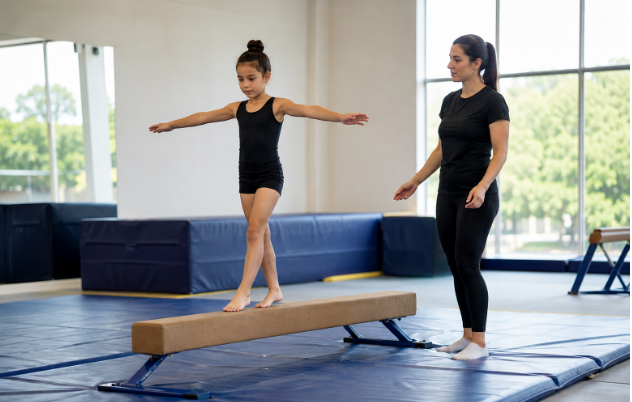
Balance is one of the first physical skills gymnasts need to build, and it influences almost every movement they learn later. From standing with control to landing safely and changing direction, strong balance creates a better foundation for progress. For beginners especially, beam-based training can help make technique more consistent from an early stage. A well-chosen Gymnastic Beam can support this kind of structured practice at home or in a supervised training setting.
Why balance matters in gymnastics
Gymnastics relies on precision. Even basic skills involve posture, alignment, coordination and timing, all working together at once. Balance training helps children and beginners become more aware of where their body is in space, which is an important part of movement control.
This awareness improves more than beam work alone. It can also support floor routines, vault preparation and transitions between skills. When athletes can stabilise their body efficiently, they often find it easier to focus on technique rather than simply trying to stay upright.
Balance also encourages patience. Progress on the beam tends to happen through repetition and small improvements, which can help build concentration and confidence over time.
See also: How Cognitive Behavioral Therapy in Santa Clara Helps You Rebuild Your Thoughts and Your Life
How beam practice builds coordination
Coordination develops when the body learns to manage multiple actions smoothly. On the beam, even walking forward in a straight line requires the feet, core, arms and eyes to work together. That combination makes the beam a useful training tool for improving controlled movement.
Simple drills can support this development. Marching steps, heel-to-toe walking, pauses in place and arm position changes all challenge coordination without needing advanced ability. These exercises may look basic, but they teach important movement habits that apply across the sport.
As skills progress, coordination becomes even more important. Turns, jumps and holds all depend on the athlete being able to control body position while staying centred.
Confidence grows through controlled repetition
Many beginners feel uncertain when trying a narrow surface for the first time. That is normal. What often helps is repetition in a safe and manageable format. Starting with simple tasks and repeating them regularly allows confidence to build naturally.
This process is valuable because confidence in gymnastics is not only emotional. It is also physical. When an athlete has repeated a movement enough times, it starts to feel familiar. That familiarity reduces hesitation and helps them move with more control.
Beam practice can be especially useful for children who benefit from predictable routines. A short sequence of walking, stopping, balancing and stepping off safely can create structure without feeling overwhelming.
Choosing the right beam for beginner use
Not all beams are suited to the same environment or skill level. For beginners, the main priorities are usually stability, appropriate height and a surface that supports comfortable foot placement. Home users often look for options designed for introductory training rather than competition-style performance.
The intended use matters as well. Some families want a beam for occasional skill reinforcement, while others want something that becomes part of a regular weekly routine. In both cases, the goal should be safe, supervised practice that matches the gymnast’s stage of development.
Space is another practical consideration. A beam needs enough surrounding room for mounting, stepping off and moving safely. Even the best equipment works best when the training area is set up thoughtfully.
Safe habits are part of effective training
Beam training is most useful when safety is part of the routine from the start. Warm-ups, clear floor space and age-appropriate drills all make a difference. Supervision is also important, especially for younger users or anyone learning new movements.
It helps to keep sessions focused and realistic. Short practice blocks often work better than long, tiring ones. Fatigue can affect posture and concentration, which increases the chance of sloppy technique.
Athletes should also be encouraged to master simple actions before moving on. Walking confidently, stopping with control and stepping down properly are all worthwhile skills in their own right.
Beam work supports long-term skill development
One reason beam training remains valuable is that it teaches habits that stay relevant as gymnastics becomes more advanced. Posture, core stability, controlled landings and body awareness are not limited to beginners. They continue to matter at every stage.
This is why early beam practice can have a wider effect than many people expect. It supports technical development, strengthens focus and gives gymnasts a structured way to improve over time. For children starting out, that kind of steady foundation can be just as important as learning the next skill.
When balance is trained consistently and safely, the benefits often show up well beyond the beam itself.