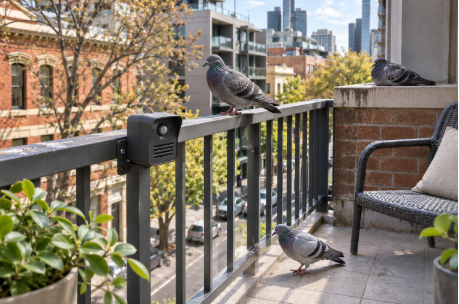
A small box that clips to a balcony rail and promises to clear pigeons with sound nobody can hear sounds like an easy fix. Hardware stores and online marketplaces sell plenty of them, often with confident packaging and glowing reviews. The research tells a less exciting story, and it starts with how birds actually hear. For anyone weighing up a bird deterrent Melbourne homes and businesses can depend on, understanding why these gadgets fall short can save money and months of frustration. This guide looks at the evidence, explains where sound does have a role, and covers what tends to work instead.
How Birds Hear Compared With People
Ultrasound is sound above roughly 20,000 hertz (20 kHz), the upper limit of hearing for a healthy young adult. Many people assume birds hear higher pitches than we do, since they sing such bright, fast notes. In reality, the opposite is usually true.
A 2004 review of avian hearing by Robert Beason, a researcher with the USDA’s National Wildlife Research Center, found that birds are most sensitive to sounds between about 1 and 4 kHz. No bird species tested has shown sensitivity to frequencies above 20 kHz. Most species stop hearing well somewhere below 10 kHz, which is lower than the human upper limit.
Interestingly, pigeons appear to go the other way. Studies have shown they respond to very low frequencies (infrasound) that people cannot hear at all. So the one sound range where pigeons outperform humans is the opposite end from where ultrasonic devices operate.
What the Research Says About Ultrasonic Repellers
Testing of these devices goes back decades, and the results are remarkably consistent. A review presented at the Vertebrate Pest Conference in 1992 summarised laboratory and field trials involving starlings, pigeons, ducks and other species. Across those trials, ultrasonic units produced no meaningful change in bird behaviour.
A broader 2003 review of frightening devices, published in Integrated Pest Management Reviews, reached the same conclusion: ultrasonic devices were ineffective at repelling both birds and mammals. USDA Wildlife Services guidance on bird dispersal states plainly that ultrasonic devices do not scare birds, for the simple reason that birds cannot hear them.
There is also a physical problem. High-frequency sound loses energy quickly over distance and is easily blocked by walls, beams and even foliage. That leaves “sound shadows” behind any obstacle, so even a bird that could hear the signal would find plenty of quiet corners nearby.
See also: Why a Likable Person Test Will Help You Change Your Life
Why Some People Believe They Work
If the evidence is so clear, why do some owners swear by their device? A few explanations come up repeatedly.
- Timing. Birds come and go with breeding seasons, food supply and weather. A device installed just as numbers naturally drop can look effective.
- Audible output. Some products marketed as ultrasonic also make clicks, chirps or flashing lights that birds can detect. Any initial reaction usually comes from these, not the ultrasound.
- Novelty. A new object on a ledge can make birds cautious for a few days until they learn it poses no threat.
One side effect is worth knowing. Dogs and cats can hear well into the ultrasonic range, so a device that does nothing to pigeons may still bother household pets.
Where Sound Deterrents Can Help
Sound is not useless for bird control, but it has to be audible and it has to be managed. Recorded distress calls and alarm sounds within the birds’ hearing range can disperse flocks, and they are used at airports and on farms.
Their weakness is habituation. Birds quickly learn that a repeated noise carries no real danger, so effectiveness often fades within days or weeks unless the sounds, timing and location keep changing. These systems are also loud enough to disturb people, which makes them a poor fit for apartments, cafés and busy commercial streets. In practice, they work best as one part of a wider program run by people who adjust them regularly.
What to Use Instead on Melbourne Properties
The approaches with the strongest track record are physical. Rather than trying to frighten birds, they remove the ability to land, roost or nest in the first place. Choosing among them depends mainly on the problem you are dealing with.
- Birds sitting on ledges for short periods. Low-profile options such as tensioned wire or spikes stop pigeons from settling comfortably.
- Heavy nesting on ledges. Smooth, angled covers that birds cannot grip tend to outperform wire, because nesting birds are far more determined than resting ones.
- Birds getting inside. Gaps under roof tiles, around pipes and behind gutters need to be closed with mesh or similar material. This is common with Indian mynas and sparrows in Melbourne’s suburbs.
- Large open areas. Courtyards, loading docks and crop areas usually call for netting.
Species matters too. Silver gulls around Port Phillip Bay behave very differently from city pigeons, and a system sized for one may not stop the other. Native birds, including silver gulls, are protected wildlife in Victoria, which is one more reason humane exclusion is the sensible default.
Whatever you choose, check that it suits the surface it is fixed to, can be maintained safely, and does not trap birds already nesting inside. A well-matched barrier keeps working long after any gadget would have been forgotten.